
Maybe a neighbor mentioned it over the fence. Maybe your daughter saw something online and asked if you had signed up yet. Somewhere along the way you heard that seniors can get a card that helps pay for groceries, and now you are wondering if it is real, if you qualify, and how you would even go about getting one.
You are not imagining it. A food card for seniors is a real thing, and for the right person it can take some of the sting out of the checkout line every month. The catch is that the phrase covers two very different programs, and knowing which one you are asking about is the whole game.
Let’s walk through both, in plain language, so you know exactly where you stand and what your next step is.
What people mean by a food card for seniors
When folks talk about a food card, they usually mean one of two things. The first is SNAP, the federal food assistance program many people still call food stamps. SNAP benefits load onto an EBT card each month, and you swipe it like a debit card at the grocery store.
The second is a grocery or flex benefit that comes with certain Medicare Advantage plans, most often a dual special needs plan for people who have both Medicare and Medicaid. This card is a plan benefit, not a government check, and it works only at the stores and on the items the plan allows.
They are separate programs with separate rules. Here is the good news for a lot of seniors: if money is tight, you may be able to use both. One does not cancel out the other.
How to get a food card for seniors through a dual plan
If you have Medicare and you also have Medicaid, or your income is low enough that you might qualify for Medicaid, this is the path worth understanding first. People who have both programs are called dual eligible, and they have the widest access to plan grocery benefits right now.
A dual special needs plan is a type of Medicare Advantage plan built for people in exactly that situation. These plans usually carry a $0 monthly premium, and many of them add a card you can use toward healthy groceries and everyday items, up to a set amount, if you qualify. The amount and the rules depend on the plan, your county, and the year, so treat any dollar figure you see as a sample to confirm, not a promise.
The steps look like this. First, confirm you have both Medicare and Medicaid, or check whether your income qualifies you for Medicaid. Second, find out which dual plans are offered where you live, since availability changes county by county. Third, enroll in a plan that includes the grocery or flex benefit, and the card comes as part of that plan. You can start by checking your eligibility on our Am I Dual Eligible page, or read the plain overview on What Is a Dual Plan.
What you can usually buy with it
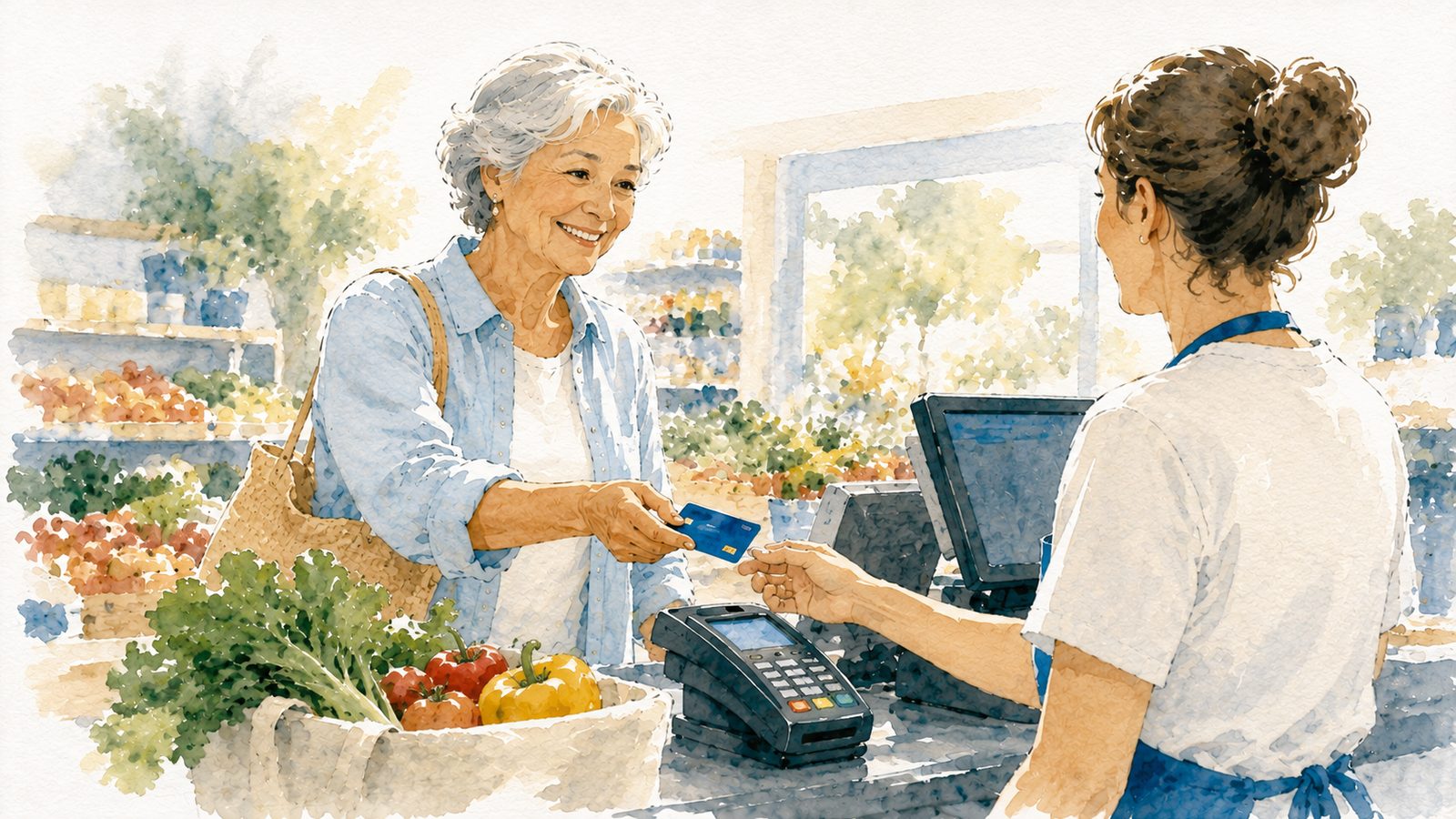
Plan grocery cards are meant for healthy, everyday food and basic household health items. On many plans that means fresh fruit and vegetables, meat and eggs, dairy, bread, pantry staples, and often over the counter items like vitamins, pain relief, and first aid supplies.
What you generally cannot buy is the fun stuff the program was never meant to cover, things like alcohol, tobacco, and prepared hot meals from the deli counter. Each plan sets its own list, so the safest move is to ask what your specific card covers before you shop.
SNAP, the other food card seniors ask about
SNAP runs on a different track, and it is worth a serious look because seniors get special treatment under its rules. If you are 60 or older, your household usually only has to pass the net income test, not the tougher gross income test, and there is a medical expense deduction that can lower your countable income even further.
For the 2026 benefit year, a single person often needs a net monthly income at or below roughly $1,305, with an asset limit near $4,500 for households that include someone 60 or older. Those figures shift, so check the current numbers for your state before you rule yourself out.
You apply for SNAP through your state or county human services office, not through a Medicare plan. If you are approved, the benefit lands on an EBT card each month. Many seniors who qualify for a dual plan also qualify for SNAP, which is why it pays to look into both rather than picking one and stopping there.

How much is on the card, and the catch to know
For a plan grocery benefit, sample amounts tend to fall somewhere in the range of $25 to $200 a month, with some dual plans on the higher end. Please read that as an example only. The real amount depends on the plan, your county, and the plan year, and it can change each January.
There is one rule that trips people up. Most plan cards are use it or lose it, meaning the amount resets at the start of each month and does not roll over. If your card gives you a monthly grocery allowance, the habit that serves you best is to spend it down before the month ends rather than saving it up.
SNAP works differently. Unused SNAP benefits generally do carry over month to month for a while, so the two cards do not behave the same way at all.
What changed in 2026
You may have heard that these grocery cards got harder to find, and that is true for the general Medicare crowd. Starting with the 2026 plan year, Medicare tightened the rules on food and grocery benefits. On regular Medicare Advantage plans, a food benefit now generally requires a documented qualifying health condition, so many people who had one in past years no longer see it.
Here is the part that matters for you. Dual eligible members kept the broadest access. If you have both Medicare and Medicaid, you are in the group most likely to still find a plan that offers a grocery or flex benefit, which is one more reason the dual plan path is the one to check first if you qualify for both.
Key takeaways
A food card for seniors usually means one of two things: SNAP food benefits on an EBT card, or a grocery benefit that comes with certain Medicare plans. SNAP comes from your state, and seniors get easier income rules. The plan grocery card comes from a dual special needs plan, most often for people who have both Medicare and Medicaid, and it is a plan benefit up to a set amount, if eligible, never a government check or free money.
Amounts vary by plan, county, and year, plan cards are usually use it or lose it, and after the 2026 rule changes duals have the best shot at a plan that still includes one. Many seniors can look into both programs at the same time.
Frequently asked questions
Is the senior food card free money from the government? No. SNAP is a federal food assistance benefit with its own income rules, and a plan grocery card is a benefit from a private Medicare plan, up to a set limit if you qualify. Neither one is cash you can withdraw.
Can I have SNAP and a dual plan grocery card at the same time? Often, yes. They are separate programs, so qualifying for one does not disqualify you from the other. Many dual eligible seniors use both.
Do I lose my Medicaid if I join a dual plan? No. You keep your Medicaid when you join a dual special needs plan. The plan works alongside it.
How do I find out if a plan in my area offers the card? The fastest way is to talk it through with a licensed agent who can look at the plans offered where you live. You can reach one using the number below.
Ready to see if you qualify?
If you have Medicare and Medicaid, or you think your income might qualify you for both, it is worth a quick, free conversation to see which dual plans are offered in your area and whether any of them include a grocery benefit this year. There is no obligation, and you can ask as many questions as you like.
Call (800) 000-0000My Dual Plan is a private information and referral service, not an insurance company, agency, or licensed producer. When you call, you are connected with a licensed insurance agent who can discuss the dual special needs plans they offer in your area. We are not affiliated with, endorsed by, or connected to Medicare, Medicaid, CMS, or any government agency. We do not offer every plan available in your area. Any information we provide is limited to the plans we do offer in your area. Please contact Medicare.gov or 1-800-MEDICARE to get information on all of your options.