
The mail piled up on the kitchen table for a week before Rosa sat down with her mother to open it. One envelope promised a card for groceries. Another said her mother might qualify for a plan with a $0 premium. It all sounded good, but nobody explained the one thing they actually wanted to know: what do we do next, and who do we even call?
If that sounds familiar, you are in good company. Plenty of people have both Medicare and Medicaid and never sign up for the plan built for exactly that situation. Learning how to enroll in a DSNP is simpler than the mail makes it look, and this guide walks you through it one calm step at a time.
A dual special needs plan, often written DSNP, is a type of Medicare Advantage plan for people who have both Medicare and Medicaid. It rolls both programs into a single plan and, on many plans, adds extras like a grocery and over the counter card, dental, vision, hearing, and rides to the doctor. The exact extras vary by plan, county, carrier, and year, so treat any figure you read as a sample worth confirming.
First, make sure you qualify for both programs
Before anything else, confirm the one rule that matters: to join a dual plan, you need both Medicare and Medicaid, or a qualifying level of Medicaid help. Everything else in the process depends on this.
The quickest check is your wallet. If you have a red, white, and blue Medicare card and a separate Medicaid card from your state, you very likely qualify. Some people have full Medicaid, and some have partial help through a Medicare Savings Program that pays their Part B premium or cost sharing. Both groups can usually enroll.
Not sure where you stand? You can call your state Medicaid office, or let a licensed insurance agent look it up with you when you call. If you want to read through it first, our guide on whether you are dual eligible breaks the rules down in plain language.
Gather your information before you apply
Having a few things in front of you makes the whole thing go faster. None of it is hard to find, and most of it is sitting in that same stack of mail.
Pull together your Medicare number from your Medicare card, your Medicaid ID number, and a simple list of your doctors and the medicines you take. Keep your ZIP code handy too, because plans and benefits are set at the county level. Your list of doctors and prescriptions is the part most people skip, and it is the part that helps you pick a plan that actually fits your life.

Know when you can enroll
Timing trips up a lot of families, so here is the part that brings real relief: as a dual eligible member, you often do not have to wait for one date on the calendar. You get more chances to enroll or switch than most people on Medicare.
When you first get Medicare
If you are new to Medicare, maybe you just turned 65, or you qualified earlier through a disability, you get an Initial Enrollment Period around that time. Once you have both Medicare and Medicaid, you can generally join a dual plan the month your Medicaid starts.
The fall Annual Enrollment Period
Every year, Medicare’s Annual Enrollment Period runs from October 15 to December 7. Anyone with Medicare can join, drop, or change a Medicare Advantage plan during this window, and the new plan starts January 1.
The monthly window for full duals
Here is the piece that surprises people. If you have full Medicaid, you can use a special monthly enrollment period to move into an integrated dual plan that lines up with your Medicaid coverage. That means you may be able to switch once a month instead of waiting until fall. This monthly integrated option is for full duals; if you have partial Medicaid or only Extra Help, you have a monthly window to change a drug plan but not the full integrated switch.
There is also the Medicare Advantage Open Enrollment Period from January 1 to March 31, when you can make one change if you are already in a Medicare Advantage plan. If all these windows blur together, that is normal, and a quick call can sort out which one applies to you today.

How to enroll in a DSNP, step by step
Once you know you qualify and you have your details together, the actual sign up is short. Here is the whole path from start to finish.
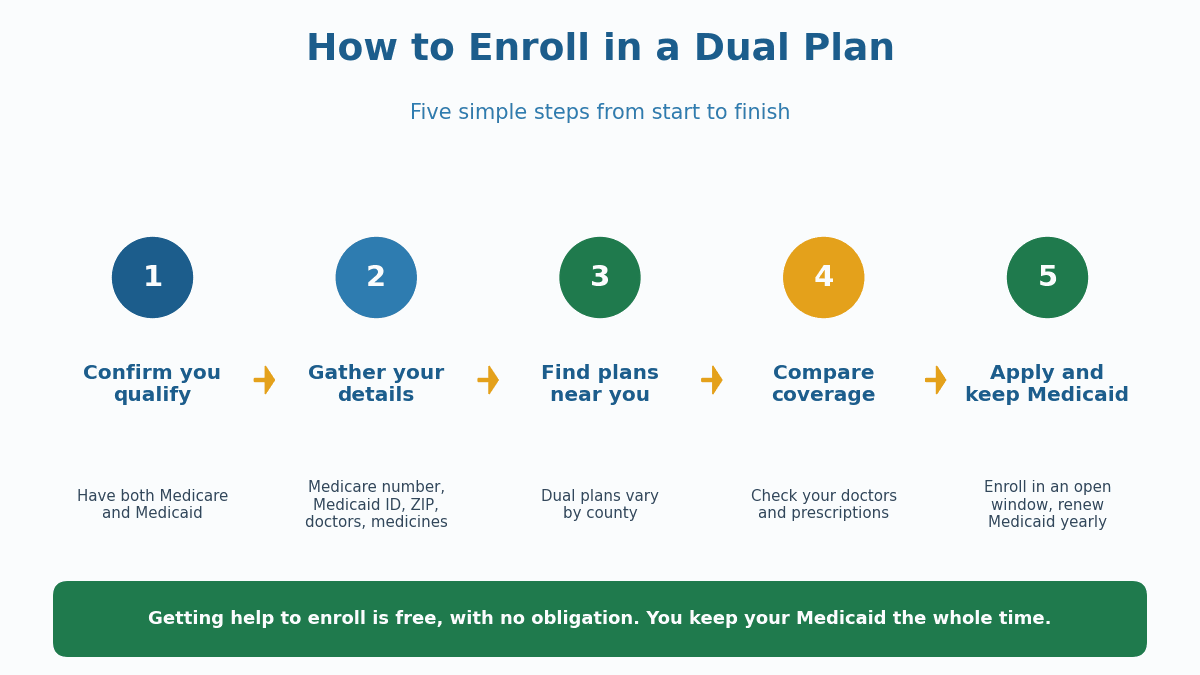
Step one: confirm you have both Medicare and Medicaid, or a qualifying Medicare Savings Program. Step two: gather your Medicare number, Medicaid ID, ZIP code, doctors, and medicines. Step three: find out which dual plans are offered in your county, since availability changes from place to place. Step four: compare what each plan covers, including the extras that matter to you, and check that your doctors and prescriptions are covered. Step five: apply during a window that is open for you, then keep your Medicaid active so your coverage stays in place.
You can apply a few different ways. Many people find it easiest to call and talk it through with a licensed insurance agent who can check plans in their area, confirm eligibility, and handle the paperwork on the phone. You can also apply online or by mail. If you would like a fuller picture of the plan itself first, our overview of what a dual plan is and our explainer on the $0 premium dual plan are good places to start.

What happens to your Medicaid
This is the worry that stops people from picking up the phone, so let’s clear it up plainly. You keep your Medicaid when you join a dual plan. Enrolling in a Medicare Advantage plan, including a dual plan, does not cancel or replace your Medicaid benefits.
Your dual plan works alongside Medicaid, not instead of it. The one thing to stay on top of is your yearly Medicaid renewal, sometimes called redetermination. As long as you keep your Medicaid active, your dual plan coverage stays steady.
What it costs to get help
Talking to someone about how to enroll in a DSNP does not cost you anything. There is no fee to call, no obligation, and no pressure to sign up. A licensed insurance agent can review the dual plans offered in your area, and the choice is always yours.
Most dual plans carry a $0 premium, though the Part B premium and any cost sharing are separate matters that Medicaid often helps with for full duals. As always, the exact dollars depend on your plan and your county, so confirm the numbers for your own situation before you decide.
Key takeaways
To join a dual plan you need both Medicare and Medicaid, or a qualifying level of Medicaid help. Gather your Medicare number, Medicaid ID, ZIP code, doctors, and medicines before you apply. Full dual members often get a monthly chance to enroll or switch, on top of the fall Annual Enrollment Period. You keep your Medicaid the whole time, as long as you complete your yearly renewal. And getting help to enroll is free, with no obligation.
Frequently asked questions
Do I need Medicaid to enroll in a dual plan?
Yes. A dual plan is built for people with both Medicare and Medicaid. Full Medicaid qualifies, and so does partial help through a Medicare Savings Program that covers your Part B premium or cost sharing.
Can I enroll at any time of year?
Often, yes. Full dual members can use a monthly special enrollment period to move into an integrated dual plan, and everyone with Medicare can join or change during the Annual Enrollment Period from October 15 to December 7. A quick call can tell you which window is open for you.
Will I lose my Medicaid if I join a dual plan?
No. Joining a dual plan does not affect your Medicaid. The plan works alongside Medicaid. Just complete your yearly Medicaid renewal to keep everything active.
How long does enrollment take?
The application itself is usually short, especially by phone with a licensed agent. Once you apply during an open window, coverage typically starts the first day of the following month.
Ready to see if you qualify?
If you have both Medicare and Medicaid, or you think you might, the simplest next step is a quick, free call. Someone can check whether you qualify and walk you through the dual plans offered in your area, with no obligation to enroll.
Call (800) 000-0000You can also reach us at (800) 000-0000. Take your time, ask every question, and only move forward if it feels right for you.
My Dual Plan is a private information and referral service. We are not an insurance company, an insurance agency, or a licensed producer. When you call, you are connected with a licensed insurance agent who can discuss the dual special needs plans they offer in your area. We are not affiliated with, endorsed by, or connected to Medicare, Medicaid, CMS, or any government agency. We do not offer every plan available in your area. Any information we provide is limited to the plans we do offer in your area. Please contact Medicare.gov or 1-800-MEDICARE to get information on all of your options. Plan benefits, premiums, and card amounts are samples that vary by plan, county, carrier, and year, and should be confirmed for your own situation.