
There’s a moment that trips up almost everyone. You’re at the front desk of a doctor’s office, you slide your cards across the counter, and the person behind the glass asks which one is your primary. You pause. Both cards look official. Both words start with the same six letters. Neither one explains itself.
You’re not slow, and you’re not the only one. Congress signed both programs into law on the same afternoon in the summer of 1965, gave them names four letters apart, and then built them to do completely different jobs. Most of the confusion around medicaid vs medicare comes from the naming, not from you.
One sentence that keeps them straight
Medicare cares about your age. Medicaid aids you when your income is low.
Say that twice and it tends to stick. Medicare follows a birthday. You get it at 65, or earlier if you’ve been on Social Security disability for a while. What you earn has nothing to do with whether you qualify. A retired surgeon and a retired janitor get the same Medicare on the same terms.
Medicaid follows a budget. It’s built for people whose income and savings are limited, and age isn’t the point. A 30 year old, a 50 year old, and an 80 year old can all be on Medicaid for exactly the same reason.
Two different doors. And plenty of people walk through both.
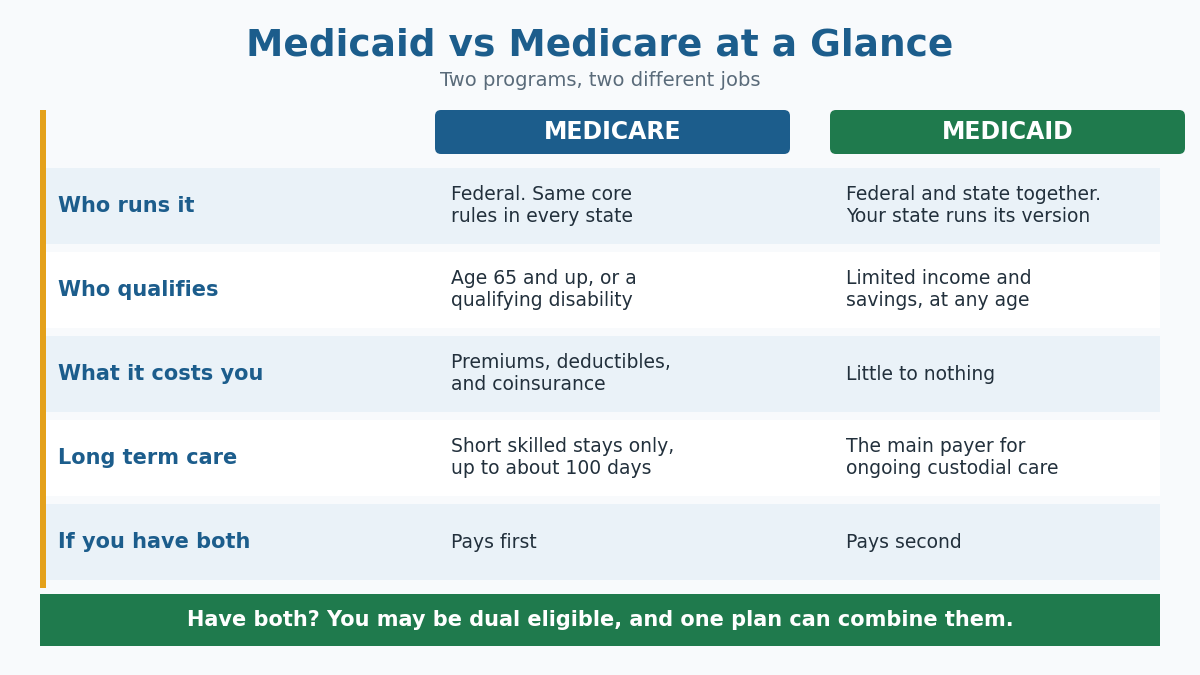
Medicaid vs Medicare, side by side
Once you know which door is which, the rest falls into place quickly.
Who runs it. Medicare is federal. The core rules are the same whether you live in Ohio or Arizona. Medicaid is a partnership between the federal government and your state, and your state runs its own version of it. That’s why a friend one state over can have different coverage, different income limits, and even a different name for the program entirely.
What it costs you. Medicare has real money baked into it. Part B carries a monthly premium, and Parts A and B leave you with deductibles and coinsurance every year. Medicaid asks little to nothing from the people it covers, which is the whole point of a program built around limited income.
What it covers. There’s a lot of overlap. Doctor visits, hospital stays, and lab work show up on both sides. The gap between them opens up somewhere most families never think to look, and we’ll get there in a minute.

Which one pays first
Back to that front desk. If you have both, the answer never changes: Medicare pays first. It’s your primary insurance. Medicaid pays second and picks up what Medicare leaves behind.
Picture one bill and two payers standing in line. Medicare looks at it first and covers its share. Whatever is left slides down to Medicaid, which pays what your state’s rules allow.
That second position sounds like the small job. It isn’t. Medicaid can cover your Medicare premiums, your deductibles, and your coinsurance, and it can pay for care Medicare doesn’t touch at all. For a lot of people, the second payer is the reason the first one becomes affordable.
The nursing home question
Ask most families what Medicare covers in a nursing home and they’ll say all of it. That answer is the most expensive misunderstanding in this entire subject.
Medicare pays for short, skilled stays only. Up to about 100 days after a qualifying hospital stay, and only for as long as you genuinely need skilled care. It does not pay for custodial care, which is the day after day help with bathing, dressing, eating, and getting around that most people actually picture when they think of a nursing home.
Medicaid does pay for that. Medicaid is the country’s main payer for long term care, covering room and board, help with daily activities, skilled nursing, and medications in that setting. It’s the reason families who never expected to deal with Medicaid end up learning its rules anyway.
If you take one thing from medicaid vs medicare, take this one. The program people assume covers long term care mostly doesn’t, and the one they overlook is the one that does. You can read the fuller breakdown on our Medicare vs Medicaid page.
What happens if you have both
So far this has treated medicaid vs medicare as an either or question. For a lot of people it isn’t one.
Roughly 12 million people in this country have Medicare and Medicaid at the same time. There’s a name for it. You’d be dual eligible, and it’s a genuinely good position to be in, because your coverage stacks instead of competing.

The catch is the paperwork. Two programs mean two cards, two networks, two phone numbers, and two sets of letters in the mail that don’t reference each other.
That’s the problem a dual special needs plan is built to solve. It’s a Medicare Advantage plan offered only to people who have both programs, and it wraps your coverage into one plan with one card and one number to call. These plans are almost always $0 premium, and many of them add extras like a grocery or over the counter card with a set spending limit, dental, vision, and rides to your appointments, if eligible. Any amount you see quoted is a sample. Extras vary by plan, county, carrier, and year, so it’s worth checking what’s real in your own county before you count on it.
And the worry we hear most often: you keep your Medicaid. Joining a dual plan doesn’t cancel it, doesn’t replace it, and doesn’t put it at risk. Your Medicaid keeps doing its job in the background.
About half of the people who could be in one of these plans are. Roughly 6 million of those 12 million duals have enrolled. The other half mostly didn’t say no. Nobody told them the plans existed.
Telling your cards apart
Practically speaking, your Medicare card is the red, white, and blue one with your name and a number on it. Your Medicaid card comes from your state, so there’s no single look to describe. It might be plastic, it might be paper, and it probably has your state’s name or program name on it somewhere.
If you’re in a Medicare Advantage plan, you’ll also carry a card from that plan, and that’s the one the front desk usually wants. In a dual plan, you may end up carrying just the one card for nearly everything, which is a small mercy at the pharmacy counter.
Not sure what you actually have? Your state Medicaid office can confirm your Medicaid status, and 1-800-MEDICARE can confirm your Medicare. If you’d rather not make two calls, our Am I Dual Eligible page walks through the same check in plain language.

Key takeaways
- Medicare goes by age or disability. Medicaid goes by income. That single line settles most of the confusion.
- Medicare is federal with consistent rules. Medicaid is run by your state, so your details depend on where you live.
- If you have both, Medicare always pays first and Medicaid pays second, covering premiums, cost sharing, and care Medicare skips.
- Medicare covers short skilled nursing stays. Medicaid is the main payer for ongoing long term care.
- Having both makes you dual eligible, and a dual special needs plan can combine them into one plan, usually at $0 premium, while you keep your Medicaid.
Common questions
Can you have Medicare and Medicaid at the same time?
Yes. About 12 million people do. They’re designed to work together, with Medicare in front and Medicaid behind it.
Does Medicaid pay my Medicare premium?
It can. Depending on your income and your state’s rules, Medicaid may cover your Part B premium along with deductibles and coinsurance. Your state decides the specifics.
If I join a dual plan, do I lose my Medicaid?
No. Your Medicaid stays exactly as it is. A dual plan changes how your Medicare benefits are delivered, not whether you have Medicaid.
Which one covers a nursing home?
Medicaid, for ongoing custodial care. Medicare only covers short skilled stays, generally up to about 100 days after a qualifying hospital stay.
Is a dual plan the same as regular Medicare Advantage?
Not quite. A dual special needs plan is a type of Medicare Advantage plan, but only people with both Medicare and Medicaid can join, and it’s built around that combination. Our What Is a Dual Plan page covers how it works.
A note about who we are
My Dual Plan is a private information and referral service. We’re not an insurance company, an insurance agency, or a licensed producer. When you call, you’re connected with a licensed insurance agent who can talk through the dual special needs plans available in your area. We’re not affiliated with, endorsed by, or connected to Medicare, Medicaid, CMS, or any government agency. We do not offer every plan available in your area. Any information we provide is limited to the plans we do offer in your area. Please contact Medicare.gov or 1-800-MEDICARE to get information on all of your options.
Still not sure which one you have?
That’s an ordinary place to be, and it’s a quick thing to sort out. If it turns out you have both, you may qualify for a plan that pulls them together and adds benefits you’re not getting today. A short call is free, there’s no obligation, and you’ll know where you stand when you hang up.
Call (800) 000-0000