
Say you picked a plan for your mother last fall, and now a neighbor down the street mentions her plan has a bigger grocery benefit and covers a ride to the doctor. Your first thought is probably, “Are we stuck until next October?” It’s a fair worry. For most people on Medicare, the answer really is wait for the fall. But if your mom has both Medicare and Medicaid, the rules work in her favor.
People who qualify for both programs often have far more freedom to change plans during the year than everyone else. That freedom comes from a set of special rules built just for them. Below, you’ll see exactly who gets that flexibility, how often you can use it, and what the recent changes mean for 2026.

Why dual eligibles get extra flexibility
Regular Medicare has tight windows. Once the fall enrollment season closes on December 7, most people are locked into their choice for the year, with only a few exceptions. That structure exists to keep things orderly.
People with both Medicare and Medicaid are treated differently on purpose. Their income is limited, their health needs often change, and the government wants them to be able to move to a plan that fits without waiting months. So Medicare gives this group its own chance to change, spread through the year instead of packed into the fall. That is the heart of the dual eligible special enrollment period.
Here’s the key thing to understand up front: this is not one single rule. It’s really two separate windows that got reshaped in 2025, and they cover slightly different things. Knowing which one applies to you saves a lot of confusion.
What changed in 2025 and 2026
For years, dual eligibles could switch plans once each quarter, in the first nine months of the year. That old quarterly window ended on January 1, 2025. In its place, Medicare created two newer, more focused options that carry into 2026.
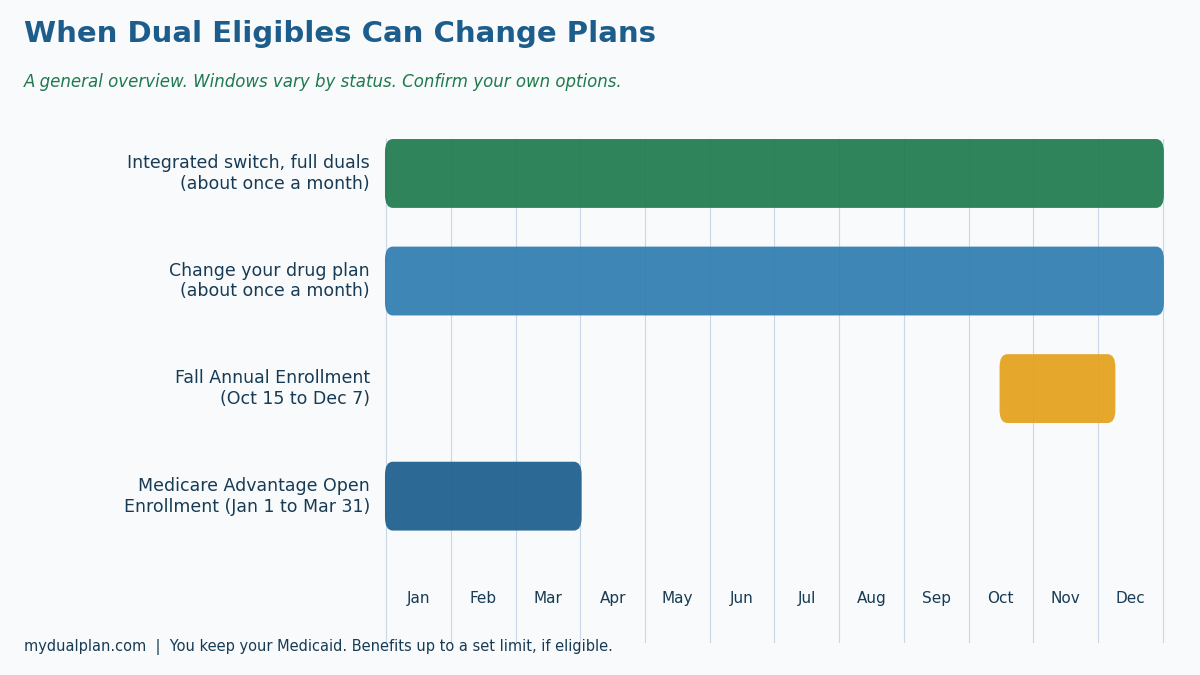
The first is an integrated care chance to switch. Full duals can move, as often as once a month, into a dual special needs plan that is closely tied to their Medicaid coverage. The second is a monthly window to change just your drug coverage. Both are meant to line up your Medicare and Medicaid so they work together as one, rather than as two plans that ignore each other.
One more change is coming. Starting in 2027, some dual plans will only accept members whose Medicaid is managed by the same company that runs the plan. That is a year away and does not block you today, but it is part of why lining up your two programs now matters. Any plan detail like this can shift, so treat it as general guidance and confirm your own situation before you act.

Who can use the dual eligible special enrollment period
This is where people get tripped up, so it’s worth slowing down. The flexible monthly move into an integrated plan is built for full dual eligibles. Those are folks who get the fuller share of Medicaid help, sometimes called QMB Plus, SLMB Plus, or full benefit dual eligible.
If you are a partial dual, meaning Medicaid helps with some of your Medicare costs but not the full package, the monthly switch into an integrated plan is not open to you. The same is true if you only receive Extra Help, also called the Low Income Subsidy, without Medicaid itself.
That said, partial duals and people with Extra Help still get their own monthly chance to change their standalone drug plan, or to drop a Medicare Advantage plan and go back to Original Medicare with a separate drug plan. So almost everyone in this broader group has more room to adjust than a person with Medicare alone. The details just depend on your exact status.
Not sure which bucket you fall into? That’s common, and it’s one of the most useful things to check, because your Medicaid level decides which doors are open. A quick look at your Medicaid paperwork, or a short call, can sort it out.
The other windows you can still use
The dual eligible special enrollment period is not your only path. You also keep every window that any Medicare member gets, which means even more chances to review your coverage.
The big one is the fall Annual Enrollment Period, which runs October 15 to December 7 each year. During that stretch, anyone on Medicare can join, switch, or drop a Medicare Advantage or drug plan, with changes starting January 1. There is also the Medicare Advantage Open Enrollment Period from January 1 to March 31, when someone already in a Medicare Advantage plan can make one change.
Stack those on top of the monthly options for duals, and you can see why people with both programs rarely need to feel trapped. The freedom is real. The trick is simply knowing when each window opens and which plans you’re allowed to move into during it.
What “switching” actually gets you
A dual special needs plan, often shortened to D SNP, rolls your Medicare and Medicaid into a single Medicare Advantage plan. Most carry a $0 monthly premium for people who qualify, and many add extras like a grocery or over the counter card, dental, vision, hearing, and rides to medical visits.
Those extras are worth an honest word. Any card amount you might hear, say a sample figure somewhere from $25 to $200 a month, is exactly that, a sample. Real amounts change by plan, by county, by carrier, and by year, and a benefit like this is available up to a set limit and only if you are eligible. It is a plan benefit, not cash, not a check from the government, and not “free money.” Always confirm the current figure for a specific plan in your area before you count on it.
Switching also does not put your Medicaid at risk. This surprises people, so it’s worth saying plainly: you keep your Medicaid when you join a dual plan. The dual plan sits alongside it and helps the two work together. You are not trading one for the other.

How to use your window without the stress
If you think a different plan might fit your parent, or you, better than the current one, here’s a calm way to approach it. Start by confirming the Medicaid level, since that decides which monthly options apply. Then compare what matters most, usually the drug coverage, the doctors in the network, and the everyday extras.
Because the monthly move for full duals is meant to align your plan with your Medicaid, the smoothest switches tend to be into a dual plan tied to the same Medicaid coverage you already have. A licensed insurance agent can look at what is offered in your county and walk you through it, so you are not guessing from a website.
There’s no rush to decide today. But there’s also no need to white knuckle it until October if a better fit exists and your window is open now.

Key takeaways
Most Medicare members wait for fall to change plans. People with both Medicare and Medicaid usually do not have to. The old quarterly switch ended in January 2025 and was replaced by two monthly options that carry through 2026.
Full dual eligibles can move into an aligned dual plan roughly once a month. Partial duals and Extra Help only members get a monthly chance to change drug coverage, though not the full integrated switch. Everyone also keeps the fall Annual Enrollment Period and the winter Open Enrollment Period. And through all of it, you keep your Medicaid, and any benefit figure you see is a sample that varies by plan, county, carrier, and year.
Frequently asked questions
Can dual eligibles really change plans anytime? Not literally any day for any reason, but far more often than people on Medicare alone. Full duals can use the dual eligible special enrollment period to move into an aligned dual plan about once a month, and there are extra windows on top of that.
Does switching plans affect my Medicaid? No. You keep your Medicaid. A dual plan works together with it, not instead of it.
What if I only have Extra Help and not Medicaid? You still get a monthly chance to change your standalone drug plan, but you cannot use the full integrated switch that is reserved for full dual eligibles.
Will these rules change again? Some do. Starting in 2027, certain dual plans will only take members whose Medicaid is run by the same company. Rules and plan details shift over time, so confirm your own options before making a move.
See if you can switch to a plan that fits you better
If you have both Medicare and Medicaid, you may have more freedom to change plans right now than you realize. The simplest next step is a quick, free call with no obligation, to check your Medicaid level and see which dual special needs plans are offered in your area. You can reach a licensed insurance agent at (800) 000-0000 or use the button below.
Call (800) 000-0000Want to make sure you qualify first? Read Am I Dual Eligible to check your status, or start with What Is a Dual Plan to see how these plans work.
My Dual Plan is a private information and referral service. We are not an insurance company, an insurance agency, or a licensed producer, and we are not affiliated with, endorsed by, or connected to Medicare, Medicaid, CMS, or any government agency. When you call, you are connected with a licensed insurance agent who can discuss the dual special needs plans they offer in your area. We do not offer every plan available in your area. Any information we provide is limited to the plans we do offer in your area. Please contact Medicare.gov or 1-800-MEDICARE to get information on all of your options.